Keeping Your Relationship Strong as New Parents
When you're both running on empty and the relationship is the thing that keeps not getting tended to
What nobody warned you about
Everyone tells you that having a baby is hard. What they don't quite capture is the specific way it's hard on a relationship. It's not usually dramatic. It's more insidious. You and your partner are both exhausted, both overwhelmed, both doing more than you've ever done, and somehow in the middle of all that, you become logistical partners instead of romantic ones.
The conversations are about feeding schedules and pediatrician appointments and who's doing the 3am feed. The time you used to spend together (talking, being present, just existing in the same space without a purpose) has been completely crowded out. It's nobody's fault. It's just what happens.
The couples who come out of new parenthood with a strong relationship aren't the ones who somehow had more time or less chaos. They're the ones who acknowledged what was happening and kept making small deliberate choices to stay connected through it.
What actually helps
Lower the bar for connection
A date night every week is unrealistic in the newborn phase. But a ten-minute conversation after the baby goes down? That's achievable. A cup of tea together while the baby sleeps? That counts. Lower the bar for what qualifies as "time together" and you'll find you have more of it.
Say thank you for the specific things
When you're both in survival mode, appreciation tends to get lost. Nobody says thank you for the 2am diaper change because you're both too tired and it's just what has to happen. But those acknowledgments matter. "Thank you for getting up last night" costs nothing and lands differently than you'd expect when everything is hard.
The couples who maintain goodwill through the early months are the ones who keep naming what they see each other doing, even when it seems redundant. It's not redundant. People need to know their effort registers.
Talk about more than the baby
This is harder than it sounds. The baby is consuming all the bandwidth, and there genuinely isn't much else to report. But making a habit of occasionally asking "how are you doing, not as a parent, just as a person" keeps the other dimensions of each other visible. You were people before you were parents, and that's worth maintaining.
Divide labor transparently
Resentment in new parent relationships often builds around invisible labor: one person feeling like they're doing more but not being able to say it without sounding like they're keeping score. Get ahead of this by making the division visible and explicitly agreed on. Not because you're keeping score, but because clarity is kinder than assumption.
Plan for when it gets easier
The newborn phase ends. Things get more manageable. Having something to look forward to (a trip you want to take, a date night you want to have, a version of normal that's coming) makes it easier to sustain in the hard stretch. Hope is a resource.
Give each other solo time
Every new parent needs time that's not about the baby. Even just an hour. Each person getting that time (without guilt on the giving end) is one of the more practical gifts you can give each other. A depleted person can't be a good partner. Taking turns recovering is both generous and strategic.
The things worth saying out loud
Most new parents are having internal experiences that they're not sharing with their partner because the timing is never right, or because they don't want to add to the load, or because they're not sure how to say it. Loneliness in the middle of a crowded new family. Grief for the version of the relationship that existed before. Fear about whether they're doing it right. These things don't go away if you don't say them.
If there's one conversation worth having, it's this one: "How are you actually doing? Not the version you're presenting. The real version." Most new parents have been waiting for someone to ask.
When to ask for help
If one or both parents are struggling significantly (postpartum depression, relationship distress that isn't resolving on its own, disconnection that's getting worse rather than better), asking for professional support is a sign of maturity, not failure. A therapist or couples counselor during the first year can save years of accumulated difficulty.
📚 Recommended Reading
As an Amazon Associate, we earn from qualifying purchases at no extra cost to you.
If any of these questions sparked something worth sitting with, these books go deeper than a list of prompts can.
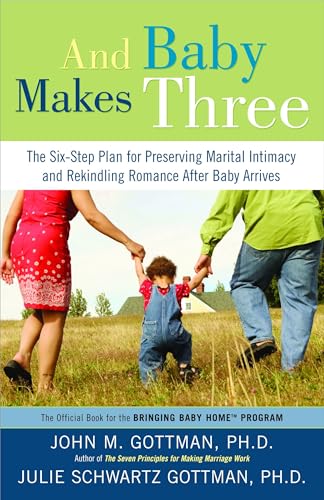
Also worth reading
What No One Tells You
Alexandra Sacks & Catherine Birndorf
A frank, empowering guide to the emotional experience of new motherhood — helping couples understand the mental and relational shifts that come with a new baby.
View on Amazon →
Also worth reading
The Whole-Brain Child
Daniel J. Siegel & Tina Payne Bryson
A revolutionary approach to child development that helps parents understand their child's brain — essential reading for couples navigating parenthood together.
View on Amazon →
Thinking about couples therapy?
Parenthood is one of the biggest stress tests a relationship faces. If it's harder than expected, support is just smart. Online-Therapy.com matches you with a licensed therapist and includes worksheets you can use between sessions.
Start with Online-Therapy.com →Get 20% off your first month when you start through our link.
Affiliate link — we may earn a commission at no extra cost to you.
Start with a conversation
We have questions for every stage of a relationship, including the ones designed for busy, tired, real people.
Browse All TopicsWritten by D.J. Westbrooks. I'm not a licensed counselor, just a 50-something who's been married 28+ years and has spent years reading what actual relationship researchers (Gottman, Johnson, Nagoski, Tatkin, Hendrix, Perel) have to say about what makes marriages last. This article is built from their work, not from a clinical degree. More about how this site gets made.
This site is not therapy. If your relationship is in real trouble, talk to a licensed professional.