Sue Johnson's three-question test for a secure relationship
Every couple argument, underneath the words, is really asking the same thing. Sue Johnson spent decades figuring out what that question is, and what it means when the answer is unclear.
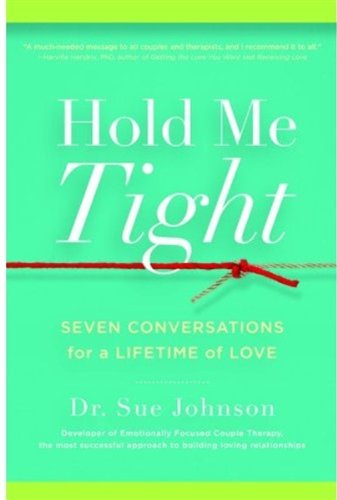
Sue Johnson is a clinical psychologist who developed Emotionally Focused Therapy, known as EFT. It's one of the most studied couples therapy approaches in existence, with decades of research behind it. She wrote Hold Me Tight in 2008, and a follow-up called Love Sense in 2013. Her central idea sounds simple, but it reshapes how you hear almost every relationship fight: adult love is an attachment bond. The same biological system that wires infants to their caregivers is the one operating when you and your partner argue about the dishes.
That reframe matters because it changes what the fights are actually about.
Most couples think they're fighting about logistics. Who forgot to call the plumber. Who spends too much. Who never wants to go out anymore. And sure, those things are real. But Johnson's position is that the content is almost never the point. Underneath the surface argument is an emotional signal, something closer to a distress call: Are you there for me?
That question, she says, is the most important one in any relationship. And the answer to it, moment by moment, across thousands of small interactions over years, is what determines whether a bond feels secure or fragile.
What the A.R.E. framework is actually testing
Johnson developed a practical framework for evaluating the health of a relationship bond. She calls it A.R.E., which stands for Accessible, Responsive, and Engaged. Each one is a specific question you can ask about how your relationship actually functions.
They're not meant to be scored like a quiz. They're meant to help you see what's missing when things feel off.
Accessible is about whether you can reach your partner emotionally. Not physically, not practically. Emotionally. Can you bring something vulnerable to them and find them turned toward you? Or do you find yourself editing what you say because you already know they'll be checked out, dismissive, or defensive? Accessibility isn't about being available every hour of the day. It's about whether the door is open.
Responsive is about whether your partner signals back that you matter to them. That your feelings register. That when you're upset or scared or need something, they notice and respond in a way that helps you feel less alone. Johnson distinguishes this from partners who are physically present but emotionally flat, people who hear you but don't really receive you.
Engaged is the deepest of the three. It's not just about being available or responding. It's about genuine presence. Being actually with someone, not just in the same room. Johnson says engaged partners turn toward each other, make real eye contact, listen without their attention drifting to their phone or the television or what they're planning to say next.
"The most important question in any relationship is: 'Are you there for me?'" That's how Johnson puts it. The A.R.E. framework is the operational version of that question, broken down into three things you can actually look for.
Why secure bonds feel different from just being in love
Johnson's work is rooted in attachment theory, which was originally developed to understand the bond between infants and caregivers. The basic finding from that research: children who have a secure attachment to a caregiver use that person as a "safe haven" when scared and a "secure base" for exploring the world. When the caregiver is consistently accessible, responsive, and engaged, the child develops confidence. When the caregiver is inconsistent or unavailable, the child develops anxiety or learns to shut down their needs entirely.
Johnson's breakthrough was recognizing the same system doesn't stop operating in adulthood. It just shifts to romantic partners. Her quote: "Love is not the icing on the cake of life. It is a basic need, like oxygen or water."
This is why the stakes in relationship conflict feel so disproportionate to the apparent topic. You're not just arguing about whether someone did the dishes. You're arguing about whether you're safe. Whether someone is reliably there for you. Whether your attachment bond is intact.
A secure attachment in a partnership gives you the same things it gave you as a child: a place to return when life gets hard, and a foundation stable enough to take risks from. Partners with that security handle conflict differently, recover from it faster, and feel fundamentally more at ease together than couples who are stuck in a state of chronic low-level uncertainty about the bond.
"Emotional dependency is not immature or pathological," Johnson writes. "It is our greatest strength." That's a direct challenge to the cultural idea that good partners shouldn't need each other too much, that relying on someone is a vulnerability to be managed rather than the actual purpose of being in a relationship.
When the A.R.E. Answers are no
The clearest sign a couple's attachment bond is under strain is what Johnson calls a Demon Dialogue. These are the repetitive patterns couples get stuck in when the underlying question ("are you there for me?") isn't getting answered clearly.
The most common one she describes is the Protest Polka: one partner pursues connection through criticism, complaints, or pushing harder; the other withdraws. The pursuer escalates because the withdrawal looks like abandonment. The withdrawer goes quieter because the pressure feels overwhelming. Each person's survival strategy is the thing that activates the other person's deepest fear. Nobody is the villain. Both are trying to protect the relationship in completely opposite ways.
The pattern looks like a conflict about something specific. But underneath it, both people are asking a version of the same question and not getting an answer they can trust.
Understanding this doesn't fix the loop automatically, but it changes what you're looking at. The fight isn't about the topic. The topic is a vehicle for something older and more urgent: the need to know whether the bond is secure.
What doing better with A.R.E. actually looks like
Johnson's therapy isn't primarily about communication skills, which separates it from most relationship advice. She's not teaching couples to use "I statements" or take turns speaking. She's working at the level of the emotional bond itself, helping partners recognize their attachment needs, express them directly, and respond to each other's signals in a way that builds security.
In practice, that often looks like slowing down during conflict to ask: what am I actually feeling underneath this? And what am I really asking for? The person who seems angry about being left off an email chain might actually be scared about being left out of decisions that affect their life. The person who seems to shut down when things get tense might be overwhelmed by a flood of signals that the bond is at risk.
Accessible, responsive, engaged: these aren't personality traits you either have or don't. They're behaviors that either show up or don't in specific moments. Most couples are doing fine on two of them and consistently missing on one. The missing one is usually where the distance lives.
The couples who do well with this work tend to get better at catching themselves mid-pattern. Not in the heat of an argument necessarily, but in the quieter moments afterward. What was I actually scared of? What did I need that I didn't ask for? What would have helped me feel more secure right then?
Those aren't easy questions. But they're the right ones.
Why this framework holds up
A lot of relationship frameworks are essentially repackaged common sense. Johnson's work is different because it's backed by serious research. EFT has a track record in clinical trials that most couples therapy approaches don't. Roughly 70 to 75 percent of couples who go through EFT move from distressed to recovered. That's a meaningful number.
The A.R.E. framework specifically is useful because it gives you a concrete way to name something that usually feels vague. Partners often know something is wrong before they can describe it. They feel distant, or lonely, or like they're roommates rather than partners. Those feelings are real, but they're hard to work with. Accessible, responsive, engaged gives you somewhere specific to look.
It's worth sitting with all three questions honestly, not just as an assessment of your partner but as an assessment of yourself. Are you accessible to them? Are you actually responsive when they reach out? Are you fully present, or are you going through the motions of being there?
Security in a relationship isn't something that gets established once. It's built and rebuilt through thousands of small moments across years. Most of them happen in ordinary minutes, a text returned quickly, a question asked and actually waited on for an answer, a hard day acknowledged with attention rather than deflected with advice.
The bond is made of those moments. Johnson's framework is a way of noticing, more precisely, which ones you're getting right and which ones keep slipping past.
It's genuinely hard to see this pattern from inside it. The framework gives you a word for what's missing, but naming the problem and changing it are two different jobs. If you can identify that one of you keeps reaching and the other keeps hesitating, and talking about it isn't moving it, that's a reasonable reason to bring in someone who does this work for a living. It doesn't mean you failed. It means the distance has gotten bigger than the two of you can close on your own.
📚 Recommended Reading
As an Amazon Associate, we earn from qualifying purchases at no extra cost to you.
If any of these questions sparked something worth sitting with, these books go deeper than a list of prompts can.
Also worth reading
Love Sense
Sue Johnson
Sue Johnson draws on the latest neuroscience to show that romantic love is a biological attachment bond — and gives couples the tools to build it for life.
View on Amazon →
Also worth reading
Attached
Amir Levine & Rachel Heller
Using attachment theory, this book explains relationship patterns and how understanding your attachment style can lead to healthier, more secure relationships.
View on Amazon →
Thinking about couples therapy?
EFT is one of the most research-backed approaches in couples therapy. If this book resonated, working with an EFT therapist is a natural next step. Online-Therapy.com matches you with a licensed therapist and includes worksheets you can use between sessions.
Start with Online-Therapy.com →Get 20% off your first month when you start through our link.
Affiliate link — we may earn a commission at no extra cost to you.
Put it into practice
Knowing the A.R.E. framework is one thing. Using it to actually talk is another. These resources help with both.
Written by D.J. Westbrooks. I'm not a licensed counselor, just a 50-something who's been married 28+ years and has spent years reading what actual relationship researchers (Gottman, Johnson, Nagoski, Tatkin, Hendrix, Perel) have to say about what makes marriages last. This article is built from their work, not from a clinical degree. More about how this site gets made.
This site is not therapy. If your relationship is in real trouble, talk to a licensed professional.